
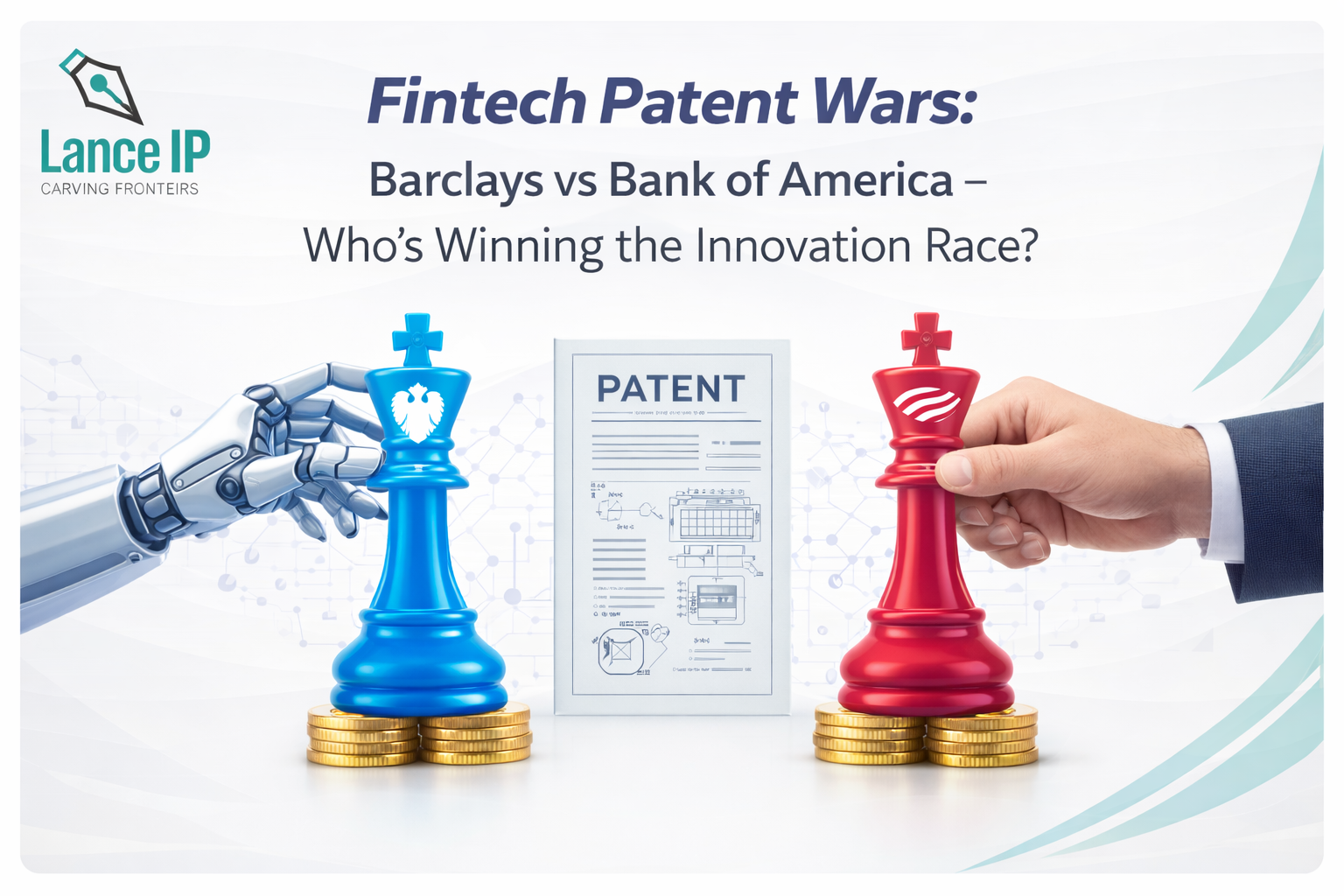
In the rapidly evolving world of fintech, patents have become more than a legal requirement—they are strategic assets that define market leadership, signal innovation capability, and influence corporate valuation. Among global banking giants, Barclays and Bank of America have adopted distinct approaches to building their patent portfolios. Understanding how their strategies differ provides insight into how intellectual property is shaping the future of financial technology.
Barclays – Niche Innovation with Strategic Depth
Barclays has built its intellectual property strategy around targeted innovation areas, focusing on technologies that are reshaping financial services.
Key areas of focus include:
Blockchain and Crypto Technologies
Barclays has pursued early patents related to crypto transaction validation, blockchain-based settlements, and smart contract mechanisms.
Payment Security
The bank has also invested in patents around contactless authentication, tokenization, and mobile payment security.
Artificial Intelligence in Compliance and Fraud Detection
Barclays has developed algorithms designed for behavioral risk profiling, fraud detection, and automated anti-money laundering (AML) systems.
Rather than filing a large volume of patents, Barclays tends to pursue fewer but highly specialized filings. Many of these innovations are developed in collaboration with startups, fintech partners, and academic institutions. Through platforms such as Rise, Barclays positions itself as both a banking institution and an innovation ecosystem partner.
Bank of America – Building a Fintech Patent Fortress
Bank of America has taken a markedly different approach by building one of the largest patent portfolios in the financial services sector.
According to recent data, the bank holds more than 5,500 active patents, making it one of the most prolific patent holders among global financial institutions.
Its patent filings span a wide range of emerging technologies, including:
- Artificial intelligence and machine learning
- Blockchain and distributed ledger technology
- Mobile banking systems
- Cybersecurity frameworks
- Cloud computing infrastructure
- Quantum computing research
- Digital identity verification technologies
One particularly notable area is distributed ledger technology (DLT). Bank of America has been one of the most aggressive patent filers in blockchain-related technologies, despite not launching its own cryptocurrency platform. This suggests a strategy focused on defensive protection and potential licensing leverage.
While Barclays emphasizes selective innovation, Bank of America’s strategy is to secure intellectual property across the entire fintech technology stack, strengthening its competitive position and negotiating power.
Comparing the Two Strategies
Both institutions demonstrate strong intellectual property leadership, but their strategies differ in key ways.
Innovation Breadth
Bank of America leads in terms of sheer patent volume and coverage across multiple emerging fintech technologies.
Strategic Focus
Barclays emphasizes depth in specific domains such as blockchain infrastructure and AI-driven financial compliance.
Commercialization Potential
Bank of America’s extensive portfolio provides greater opportunities for licensing, cross-licensing, and strategic negotiations with fintech companies and technology partners. Barclays, meanwhile, leverages agility and collaboration to move innovations into practical applications more quickly.
The Bigger Picture
The competition between Barclays and Bank of America highlights an important shift in the fintech industry. Intellectual property is no longer simply a legal safeguard—it is a strategic business asset.
For fintech startups and established institutions alike, a well-structured patent strategy determines not only technological defensibility but also market influence, partnership opportunities, and long-term competitive advantage.
As financial services continue to converge with advanced technologies, patents will increasingly shape the innovation race that defines the future of fintech.